
Kitchen Ecology Units
Industrial kitchen exhaust solutions combining grease separation, electrostatic filtration, activated carbon and a fan in one housing.
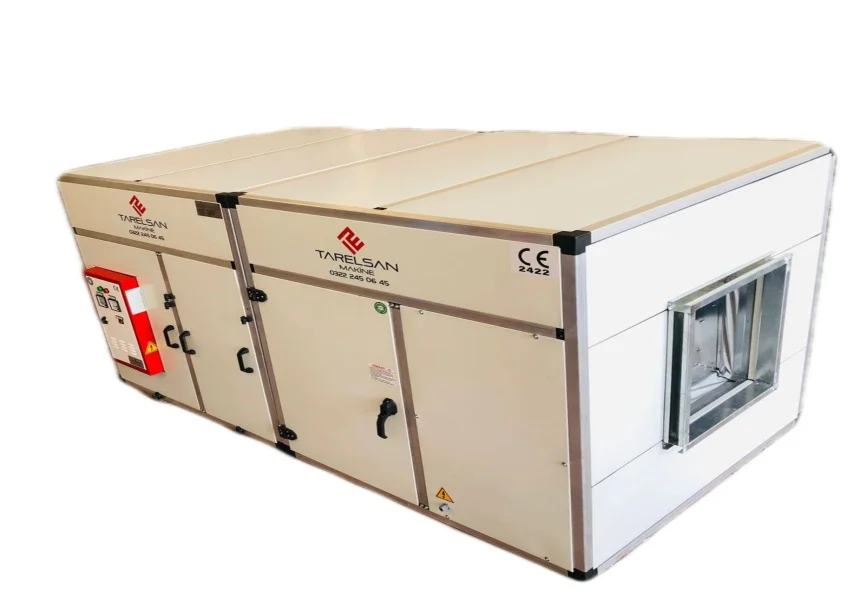
Ecology unit models
Five airflow options for kitchen exhaust. Final components and dimensions are determined by project conditions.
| Model | Airflow (m³/h) | Collector cells | Carbon cartridges | Motor power (kW) | Motor speed (rpm) |
|---|---|---|---|---|---|
| Ecology-4x | 4,000 | 1 | 24 | 1.5 | 2,800 |
| Ecology-6x | 6,000 | 1 | 32 | 2.2 | 2,800 |
| Ecology-8x | 8,000 | 2 | 40 | 3 | 1,500 |
| Ecology-10x | 10,000 | 2 | 48 | 4 | 1,500 |
| Ecology-12x | 12,000 | 2 | 64 | 5.5 | 1,500 |
Cartridge length: 40 cm. Values reflect the model data in the product catalogue; confirm the current technical scope before selection and ordering.
How does it work?
An aluminium grease pre-filter separates coarse grease particles. Electrostatic cells collect finer particles, while activated carbon adsorbs suitable gaseous and odorous compounds. The fan and speed control are selected for the required airflow. Single or double electrostatic stages can be considered according to the cooking load.
- Grease pre-separation
- Electrostatic collection
- Carbon stage and air discharge
Applications
- Restaurants, grill houses and seafood restaurants
- Hotel kitchens and catering facilities
- Cafés, fast-food outlets and food production kitchens
Key approach
- Multiple treatment stages in one housing
- Washable electrostatic cells
- Replaceable cartridge or cassette activated carbon
The right choice starts with the right data.
The following information is assessed together when selecting a system. Airflow, power, dimensions and performance values are determined for each project.
- Cooking process and equipment operating simultaneously
- Exhaust airflow and duct pressure loss
- Carbon contact time and maintenance space
Application note
Catalogue airflow is an initial reference. Filtration results depend on pollutant loading, airflow, stage selection and maintenance. Final unit specifications are confirmed in the quotation.
Frequently asked questions
How is the right system selected?
Air or process characteristics, capacity requirements and installation conditions are assessed together. The technical scope is confirmed for your application during quotation.